PDO Thread Lift Treatment High Wycombe

PDO Thread Lift Treatment High Wycombe

PDO Thread Lift Treatment: A Non-Surgical Way to Lift and Rejuvenate Your Face

If you are looking for a PDO Thread Lift Treatment in High Wycombe, you may be searching for a way to tighten loose skin and restore a youthful appearance without surgery. At Javaani Medical & Aesthetic Clinic, Dr. Ahmad offers advanced PDO thread lifting techniques designed to provide natural-looking facial rejuvenation with minimal downtime.

PDO thread lifting has become one of the most popular non-surgical cosmetic treatments because it delivers an immediate lifting effect while stimulating your body's own collagen production.

What Is PDO Thread Lift Treatment?

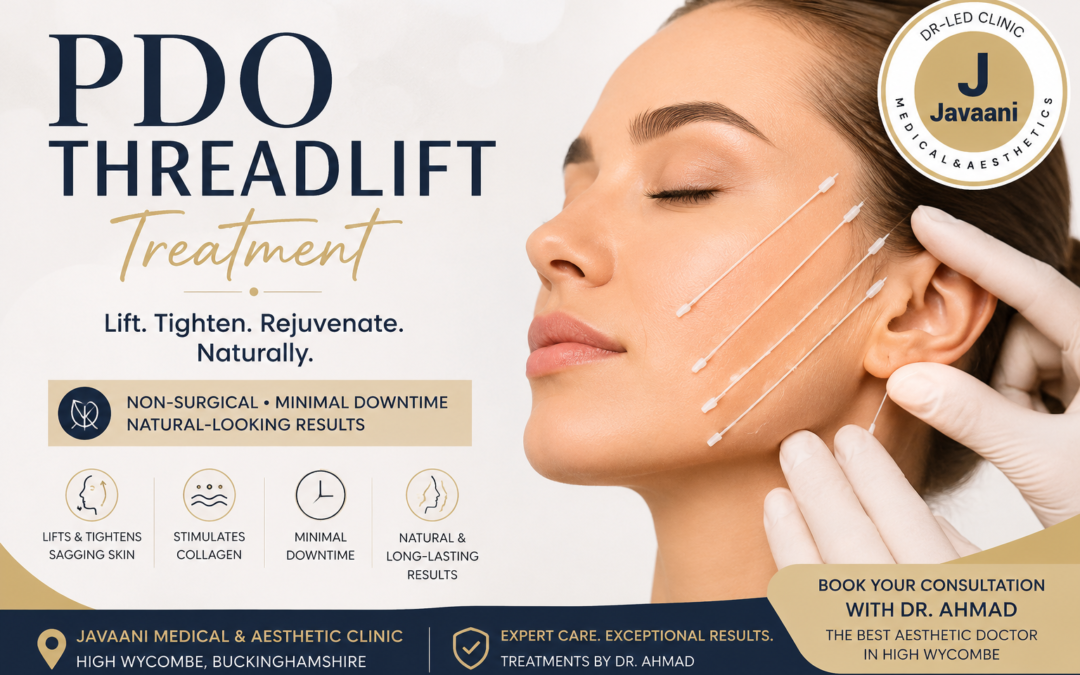
PDO (Polydioxanone) Thread Lift Treatment is a minimally invasive aesthetic procedure that uses dissolvable medical-grade threads placed beneath the skin to gently lift sagging tissues.

These threads:

  • Lift loose skin immediately
  • Stimulate collagen production
  • Improve skin firmness
  • Enhance facial contours
  • Continue improving skin quality for several months

The threads naturally dissolve over time, leaving behind stronger collagen support for smoother, firmer skin.

Which Areas Can Be Treated?

PDO thread lifts are suitable for multiple facial and neck areas, including:

  • Cheeks
  • Jawline
  • Neck
  • Eyebrows
  • Nasolabial folds
  • Marionette lines
  • Chin
  • Lower face

Treatment plans are customised according to each patient's facial anatomy and aesthetic goals.

Benefits of PDO Thread Lift Treatment

Patients choose PDO Thread Lift Treatment because it offers:

  • Non-surgical facial lifting
  • Minimal downtime
  • Immediate visible improvement
  • Natural-looking results
  • Increased collagen production
  • Improved skin elasticity
  • Long-lasting rejuvenation
  • No general anaesthesia required

It is an excellent option for people experiencing mild to moderate skin laxity.

What Happens During Treatment?

At Javaani Medical & Aesthetic Clinic, every PDO Thread Lift begins with a detailed consultation with Dr. Ahmad.

The procedure generally involves:

  1. Facial assessment
  2. Marking treatment areas
  3. Local anaesthetic application
  4. Gentle insertion of PDO threads
  5. Immediate lifting of targeted tissues

Most treatments are completed within 45–90 minutes, depending on the number of threads used.

Recovery After PDO Thread Lift

Recovery is usually straightforward.

Patients may experience:

  • Mild swelling
  • Temporary bruising
  • Slight tenderness
  • Tightness for several days

Most individuals can return to normal daily activities within 24–48 hours while following their aftercare instructions.

How Long Do Results Last?

Although the PDO threads dissolve naturally over several months, collagen stimulation continues even after the threads have disappeared.

Results commonly last between 12 and 18 months, depending on:

  • Age
  • Skin quality
  • Lifestyle
  • Number of threads used
  • Individual collagen response

Maintenance treatments can help prolong the results.

Why Choose Javaani Medical & Aesthetic Clinic?

Choosing the right practitioner is essential for achieving safe, natural-looking results.

Patients trust Javaani Medical & Aesthetic Clinic because of its:

  • Highly personalised treatment plans
  • Advanced aesthetic techniques
  • Patient-focused approach
  • Commitment to safety
  • Modern clinical environment

Treatments are performed by Dr. Ahmad, an experienced aesthetic doctor known for delivering balanced and natural facial rejuvenation while preserving facial expression and harmony.

Is PDO Thread Lift Right for You?

PDO Thread Lift Treatment is often suitable for adults who wish to improve:

  • Mild facial sagging
  • Early signs of ageing
  • Loss of jawline definition
  • Loose neck skin
  • Drooping cheeks
  • Skin laxity without undergoing surgery

A professional consultation is necessary to determine whether this treatment is appropriate for your individual needs.

Conclusion

PDO Thread Lift Treatment in High Wycombe offers an effective non-surgical solution for lifting, tightening and rejuvenating the face with minimal downtime. At Javaani Medical & Aesthetic Clinic, every treatment is carefully tailored to achieve natural-looking results while supporting long-term collagen production.

If you are considering facial rejuvenation without surgery, book a consultation with Dr. Ahmad to discuss whether PDO Thread Lift Treatment is suitable for your aesthetic goals.


FAQs

Is PDO Thread Lift painful?

Local anaesthetic is used to minimise discomfort, and most patients find the procedure well tolerated.

How soon will I see results?

Many patients notice an immediate lifting effect, with continued improvement over the following months as collagen develops.

Are PDO threads safe?

When performed by a qualified medical professional using approved medical-grade materials, PDO thread lifting is considered a safe cosmetic procedure.

How long does the procedure take?

Most treatments take between 45 and 90 minutes.

Can PDO Thread Lift be combined with other treatments?

Yes. Depending on your assessment, it may be combined with treatments such as dermal fillers, skin rejuvenation procedures or anti-wrinkle injections to achieve comprehensive facial rejuvenation.

Is Laser/IPL Safe for Darker Skin Types?

Is Laser/IPL Safe for Darker Skin Types?

Is Laser/IPL Safe for Darker Skin Types? A Doctor-Led Guide

Laser and IPL safety for darker skin types

Laser and IPL treatments can be excellent options for improving pigmentation, redness, acne marks, pores, uneven texture and early signs of ageing. However, for patients with darker or more pigmentation-prone skin, these treatments require a more careful, medical approach.

At Javaani Medical & Aesthetic Clinic in Hazlemere, High Wycombe, we see many patients with South Asian, Middle Eastern, Mediterranean, Black, mixed-heritage and olive skin tones. These skin types can respond very well to advanced aesthetic treatments, but they can also be more reactive if the wrong device, wavelength, energy setting or treatment interval is used.

The key message is simple: laser and IPL are not automatically unsafe for darker skin, but they must be selected and performed carefully. A proper consultation, skin typing, pigmentation history, patch testing and strict aftercare are essential.

Why skin type matters with laser and IPL

Light-based treatments work by targeting colour or water within the skin. IPL and many lasers interact with chromophores such as melanin in pigment and haemoglobin in blood vessels. In darker skin, there is more background melanin in the epidermis. This means the skin itself can absorb more light energy, increasing the risk of heat build-up, burns, post-inflammatory hyperpigmentation or, less commonly, hypopigmentation.

This does not mean darker skin should be excluded from energy-based treatments. It means that the treatment plan needs to be more precise. The practitioner must understand the difference between treating a pigment target and unintentionally heating the surrounding natural skin pigment.

What are Fitzpatrick skin types?

The Fitzpatrick scale is a commonly used way to describe how skin responds to ultraviolet light. It ranges from very fair skin that burns easily to deeply pigmented skin that rarely burns. It is useful, but it is not perfect. Two patients with the same Fitzpatrick type can still have very different pigmentation risks.

Fitzpatrick type

Typical response to sun

Laser/IPL relevance

I-II

Burns easily, little tanning

Often lower pigmentation risk, but still needs assessment.

III-IV

Tans gradually or easily, may burn

Common in Mediterranean, Middle Eastern and South Asian backgrounds; pigmentation risk needs careful planning.

V-VI

Rarely burns, deeply pigmented skin

Higher risk of post-inflammatory hyperpigmentation or hypopigmentation if treated incorrectly.

Why darker skin needs extra care

Darker and melanin-rich skin is more likely to develop post-inflammatory hyperpigmentation after inflammation, heat, acne, injury, burns, peels, aggressive microneedling or unsuitable laser treatment. This is why Javaani takes a cautious, clinically led approach rather than offering every laser or IPL setting to every skin type.

Important risk factors include:

  • Recent sun exposure or tanning
  • Fake tan or tanning products    
  • A personal history of post-inflammatory hyperpigmentation
  • Melasma or hormonally driven pigmentation
  • Recent acne flare or active inflammation
  • Sensitive or impaired skin barrier
  • Use of harsh exfoliants, retinoids or acids too close to treatment
  • Previous laser or IPL reaction
  • Keloid or hypertrophic scarring tendency

Is IPL suitable for darker skin?

IPL can be very useful for selected concerns such as sun damage, redness and superficial pigmentation, but it is not the best choice for every darker skin type. Because IPL is broad-spectrum light, it can interact with background epidermal melanin. This is why the wrong settings, wrong filter, excessive energy or poor patient selection can worsen pigmentation.

In some patients, a non-ablative laser, longer-wavelength device, lower-energy approach, staged treatment plan or non-energy-based treatment may be safer than IPL. The safest choice depends on the exact concern being treated, not just the skin colour.

Which concerns can be treated safely?

With appropriate assessment, darker skin types may be considered for treatment of:

  • Acne marks and post-inflammatory pigmentation
  • Uneven skin tone
  • Mild acne scarring
  • Textural irregularity
  • Large pores
  • Early fine lines
  • Some forms of superficial pigmentation
  • Some vascular concerns, depending on the device and diagnosis

The most important step is diagnosis. A brown patch may be sun damage, melasma, post-inflammatory pigmentation or another condition. Each behaves differently and should not automatically be treated with IPL.

Why melasma needs caution

Melasma is one of the most common pigmentation concerns in South Asian, Middle Eastern and Mediterranean skin types. It is also one of the conditions most likely to worsen if exposed to heat, inflammation, sunlight or inappropriate energy-based treatment.

For many patients, the safest first step for melasma is not laser or IPL. It is strict daily SPF, visible-light protection, pigment-regulating skincare and medical assessment. Energy-based treatments may be considered selectively, but they should not be presented as a quick cure.

What happens at Javaani before treatment

At Javaani Medical & Aesthetic Clinic, treatment planning begins with a detailed consultation. We assess the skin rather than simply choosing a machine setting.

  • Your skin type and ethnic background
  • Your tendency to tan, burn or pigment
  • Previous pigmentation after acne, injury or treatments
  • History of melasma
  • Recent sun exposure or holidays
  • Current skincare and active ingredients
  • Medication history
  • Whether the target is pigment, redness, scarring or texture
  • Whether a patch test is required
  • Whether a non-laser treatment would be safer

This is particularly important for patients with Asian, brown, Black or pigmentation-prone skin. A conservative plan is often the safest and most successful plan.

Patch testing and test spots

A patch test or test spot may be recommended before full treatment. This helps assess how the skin responds to the chosen setting and reduces the risk of unexpected pigmentation changes. A successful patch test does not remove all risk, but it is an important safety step when treating higher-risk skin types.

How to reduce pigmentation risk

Patients can reduce risk by preparing properly and following aftercare closely. The most important points are:

  • Avoid tanning and sunbeds before treatment
  • Do not use fake tan before laser or IPL
  • Use SPF 50 daily before and after treatment
  • Avoid harsh exfoliation before treatment
  • Tell your practitioner about retinoids, acids and prescription creams
  • Do not pick, scrub or peel the treated skin
  • Avoid heat, sauna and vigorous exercise immediately after treatment
  • Attend review appointments if the skin reacts unexpectedly

Why choose Javaani for laser/IPL in darker skin?

  • Doctor-led assessment by a medically experienced aesthetic team
  • Careful skin typing and pigmentation-risk assessment
  • Local clinic in Hazlemere, High Wycombe
  • Experience with South Asian, Middle Eastern and pigmentation-prone skin
  • Medical-grade device approach and realistic treatment planning

Strong emphasis on aftercare, SPF and complication prevention

Frequently asked questions

Can darker skin have laser treatment?

Yes, selected laser treatments can be suitable for darker skin, but the device, wavelength, settings and aftercare must be chosen carefully.

Is IPL safe for brown or Asian skin?

IPL may be suitable for some patients, but it carries higher pigmentation risk in melanin-rich skin if used incorrectly. A consultation and often a patch test are important.

Can laser make pigmentation worse?

Yes. Any treatment that causes heat or inflammation can worsen pigmentation in susceptible skin. This is why diagnosis and conservative settings matter.

Is melasma suitable for IPL?

Melasma needs caution. IPL can sometimes worsen melasma, especially if heat or light triggers the pigment. Medical skincare and strict sun protection are often the first step.

Do I need a patch test?

A patch test may be recommended if you have darker skin, a history of pigmentation, melasma, recent sun exposure or previous treatment reactions.

What is the safest treatment for darker skin?

There is no single safest treatment for everyone. The safest option depends on the diagnosis, skin type, device and treatment goal.

Book a darker-skin laser/IPL consultation at Javaani

If you are considering laser or IPL treatment and have brown, Black, Asian, Mediterranean, Middle Eastern, olive or pigmentation-prone skin, book a consultation before choosing a treatment. At Javaani Medical & Aesthetic Clinic in Hazlemere, High Wycombe, we will assess your skin carefully and advise whether laser, IPL or an alternative treatment is safest for your concern.

Clinic: Javaani Medical & Aesthetic Clinic
Location: 11A Penn Road, Hazlemere, High Wycombe, Buckinghamshire HP15 7LN
Phone: 01494 977935
Email: consultation@javaani.com
Website: Javaani.com

How to Prepare for Laser / IPL Treatment and What Aftercare Is Needed

How to Prepare for Laser / IPL Treatment and What Aftercare Is Needed

Laser and IPL preparation and aftercare at Javaani

Laser and IPL preparation and aftercare at JavaaniLaser and IPL treatments can improve pigmentation, redness, sun damage, acne marks, pores, fine lines
and skin texture. But the quality and safety of your result depends not only on the treatment itself.
Preparation and aftercare are just as important.
At Javaani Medical & Aesthetic Clinic in Hazlemere, High Wycombe, we give each patient tailored advice
based on skin type, treatment area, medical history and the device being used. This blog explains the
general principles patients should understand before booking laser or IPL skin rejuvenation.

Why preparation and aftercare matter

Laser and IPL use controlled light energy to target pigment, redness or collagen remodelling. If the skin is
recently tanned, irritated, inflamed, over-exfoliated or sensitised by skincare, the risk of unwanted side
effects increases.
Good preparation helps the skin tolerate treatment. Good aftercare helps the skin recover, reduces
pigmentation risk and supports better results.

What to do before laser or IPL treatment

Your practitioner will give specific instructions, but common preparation advice includes:

  • Book a consultation before treatment, especially if you have pigmentation, melasma or darker skin.
  • Tell your practitioner about all medications, prescription creams and recent procedures.
  • Use SPF 50 daily for at least several weeks before treatment where possible.
  • Keep the skin barrier calm and hydrated.
  • Avoid new active skincare immediately before treatment.
  • Attend a patch test if advised.
  • Arrive with clean skin and no makeup on the treatment area if instructed.

What to avoid before laser or IPL

Before treatment, avoid anything that increases heat, irritation, photosensitivity or background pigment in the
skin.

Avoid before treatment Why it matters
Sunbathing or sunbeds Tanned skin absorbs more energy and has higher burn/pigmentation risk.
Fake tan Can interfere with light absorption and increase adverse reaction risk.
Harsh exfoliation Can damage the skin barrier and increase sensitivity.
Retinoids/acids close to treatment May increase irritation depending on strength and timing.
Recent chemical peels or aggressive facials The skin may still be inflamed or recovering.
Active acne flare, infection or cold sore Treatment may need to be delayed for safety.

What happens on the day of treatment

On the day of your appointment, the practitioner will usually review your skin, check for recent sun exposure, confirm medical history and ensure there are no new contraindications. Protective eyewear is used, and the treatment area is cleansed. Depending on the treatment, cooling gel or cooling methods may be used.

During IPL you may feel a quick warm snap, similar to an elastic band flicking the skin. During non-ablative laser, you may feel warmth, prickling or a controlled heating sensation. Most patients tolerate these treatments well.

Immediate aftercare after laser or IPL

After treatment, the skin may look pink, warm or slightly swollen. Pigmented areas may temporarily darken before flaking or fading. This can be a normal response, especially after IPL for pigmentation.

General aftercare usually includes:

  • Apply SPF 50 daily and reapply when outdoors.
  • Keep the skin cool and comfortable.
  • Use gentle, fragrance-free skincare if advised.
  • Avoid picking, scratching or scrubbing.
  • Avoid strong active ingredients until advised to restart.
  • Keep the skin hydrated.
  • Follow the exact aftercare plan given at Javaani.

What to avoid after treatment

For the first few days, and sometimes longer depending on treatment intensity, you may be advised to avoid:

  • Direct sun exposure
  • Sunbeds
  • Fake tan
  • Saunas and steam rooms
  • Hot yoga or intense heat exposure
  • Vigorous exercise immediately after treatment
  • Swimming pools if the skin is sensitive
  • Retinoids, acids, scrubs and exfoliating brushes until advised
  • Picking any dry or darkened areas

The exact timeframes vary. Stronger treatment, pigmentation-prone skin and sensitive skin may require a more cautious recovery plan.

SPF 50 is essential

Sun protection is one of the most important parts of laser and IPL aftercare. UV exposure can trigger pigmentation and reduce the quality of your result. This is particularly important when treating pigmentation, melasma, darker skin types or post-inflammatory marks.

We generally recommend broad-spectrum SPF 50, used every morning and reapplied during the day if outdoors. For pigmentation-prone skin, tinted SPF with visible-light protection may also be helpful.

How long is the downtime?

Downtime depends on the treatment type, intensity and your skin response. IPL often causes temporary redness and pigment darkening. Non-ablative laser may cause redness, warmth, dryness, mild swelling or light flaking. Most patients can return to normal daily activities quickly, but social downtime can vary.

Patients should avoid planning laser or IPL immediately before a major event, holiday or period of unavoidable sun exposure.

When should you contact Javaani after treatment?

Contact the clinic promptly if you experience anything that feels more than expected, including:

  • Increasing pain or heat
  • Blistering
  • Crusting beyond expected dryness
  • Marked swelling
  • Signs of infection
  • Unexpected dark patches
  • Pale patches
  • A cold sore outbreak
  • Redness that is worsening rather than settling

Early advice is important. Do not try to self-treat a strong reaction with harsh products or internet remedies.

How to maintain your results

Laser and IPL results can be long-lasting, but they are not permanent if the skin continues to be exposed to UV, inflammation, hormonal triggers or poor skincare habits. Maintenance often includes:

  • Daily SPF 50
  • A personalised skincare plan
  • Maintenance IPL or laser sessions where appropriate
  • Avoiding sunbeds and tanning
  • Managing acne, rosacea or inflammation early
  • Reviewing pigmentation-prone skin regularly

Why choose Javaani for laser/IPL aftercare?

  • Doctor-led aesthetic clinic in Hazlemere, High Wycombe
  • Careful consultation before treatment
  • Local expertise for pigmentation, sun damage, texture and skin rejuvenation
  • Tailored aftercare rather than generic instructions
  • Clear advice on SPF, skincare and treatment timing
  • Support if the skin reacts unexpectedly

Frequently asked questions

Can I have IPL if I have a tan?

Treatment is usually delayed if you have a recent tan, sunburn or fake tan because this increases the risk of burns and pigmentation changes.

Can I wear makeup after IPL?

This depends on your skin response and the treatment area. Your practitioner will advise when it is appropriate to restart makeup.

Why do brown spots look darker after IPL?

Pigmented areas can temporarily darken after IPL before gradually flaking or fading. This can be part of the expected process, but aftercare must be followed.

How soon can I use retinol after laser or IPL?

This depends on the strength of the product and your skin recovery. Restart only when advised by your practitioner.

Can I exercise after laser or IPL?

Intense exercise is often avoided immediately after treatment because heat and sweating can aggravate the skin.

Can I go on holiday after IPL?

It is better to avoid treatment immediately before sunny holidays. Sun exposure after IPL or laser increases pigmentation risk.

Do I need SPF even in winter?

Yes. UVA is present throughout the year and visible light may also contribute to pigmentation in susceptible skin.

Book a laser/IPL consultation at Javaani

If you are planning laser or IPL treatment for pigmentation, redness, sun damage, pores, acne scars or skin rejuvenation, start with a consultation at Javaani Medical & Aesthetic Clinic. We will assess your skin, explain preparation and aftercare, and advise whether laser, IPL or another treatment is most suitable.

Clinic: Javaani Medical & Aesthetic Clinic
Location: 11A Penn Road, Hazlemere, High Wycombe, Buckinghamshire HP15 7LN
Phone: 01494 977935
Email: consultation@javaani.com
Website: Javaani.com

Laser vs IPL

Laser vs IPL

Laser vs IPL: Which Skin Rejuvenation Treatment Is Right for You?

If you are considering treatment for pigmentation, redness, sun damage, acne scars, enlarged pores or uneven skin texture, you may have come across both laser and IPL treatments. The terms are often used together, and many patients search for “IPL laser”, but they are not the same.

At Javaani Medical & Aesthetic Clinic in Hazlemere, High Wycombe, we offer doctor-led skin assessment and light-based rejuvenation treatments. The aim is to choose the right technology for your skin concern, skin type and risk profile - rather than simply choosing the treatment name that sounds most familiar.

This guide explains the difference between laser and IPL, what each treatment is usually best for, when caution is needed and how we help patients choose a safe and realistic treatment plan.

Contents

  1. What is IPL?
  2. What is laser skin rejuvenation?
  3. Laser vs IPL: the key difference
  4. Which is better for pigmentation?
  5. Which is better for redness?
  6. Which is better for acne scars, pores and texture?
  7. Which has more downtime?
  8. Which is safer for darker skin types?
  9. When should treatment be delayed or avoided?
  10. Why choose Javaani?
  11. FAQs
  12. Book a consultation

What is IPL?

IPL stands for Intense Pulsed Light. It is a broad-spectrum light treatment, not a true laser. Instead of using one fixed wavelength, IPL uses pulses of filtered light that can target different structures in the skin, including melanin in brown pigmentation and haemoglobin in redness or superficial visible vessels.

This makes IPL particularly useful for selected cases of photodamage, sun spots, age spots, uneven skin tone, redness and general skin brightening. IPL can treat relatively large areas, which is why it is sometimes called a photofacial or photorejuvenation treatment.

IPL is usually best for colour-related concerns: brown marks, red marks, visible capillaries and general uneven tone. It is less specifically focused than a laser, so careful patient selection and correct settings are important.

What is laser skin rejuvenation?

A laser uses a focused beam of light at a specific wavelength. Different lasers are designed to target different structures and depths in the skin. In aesthetic medicine, lasers may be used for resurfacing, collagen stimulation, acne scarring, pigmentation, vascular concerns, hair reduction or other indications depending on the device.

For skin quality, non-ablative laser treatments work by heating targeted layers of the skin without removing the surface. This can stimulate collagen remodelling and gradually improve texture, pores, fine lines and mild acne scarring.

Non-ablative laser resurfacing is generally less aggressive than ablative resurfacing, but results are also more gradual. A course of treatments is usually needed.

Laser vs IPL: the key difference

The simplest way to understand the difference is this: IPL uses broad-spectrum filtered light, while laser uses a more focused and specific wavelength of light.

That difference matters because it affects precision, depth, treatment goals, downtime and suitability for different skin types.

Feature IPL Non-ablative laser
Type of energy Broad-spectrum pulsed light Focused laser wavelength
Best known for Pigmentation, sun damage, redness, photorejuvenation Texture, pores, acne scarring, fine lines, collagen stimulation
Precision Less specific than laser but versatile over larger areas More specific and target-driven
Downtime Usually mild, depending on settings and skin response Usually mild to moderate for non-ablative treatments
Typical result pattern Brightening and tone improvement over a course Gradual collagen-led texture improvement over weeks to months
Suitability Excellent for selected lighter skin types and superficial pigment/redness; caution in darker or melasma-prone skin Can be tailored by device and wavelength; still requires careful assessment

Which is better for pigmentation?

For superficial pigmentation such as sun spots, freckles, age spots and general photodamage, IPL can be a very effective option in carefully selected patients. The light is absorbed by excess melanin, which may temporarily darken before gradually fading or flaking away.

Laser may be more appropriate where pigmentation is mixed with textural change, acne scarring, enlarged pores or fine lines. In some cases, a staged approach is best: first stabilising the skin with SPF and pigment-regulating skincare, then considering IPL or laser if suitable.

However, not all pigmentation should be treated with IPL. Melasma, post-inflammatory hyperpigmentation and pigmentation in darker skin types require particular caution because heat and light energy can sometimes worsen pigmentation if treatment is too aggressive or poorly selected.

Which is better for redness?

IPL is commonly used for selected forms of facial redness, visible capillaries, flushing and photodamage-related redness. It targets haemoglobin within superficial vessels and can gradually reduce the appearance of redness over a course of treatments.

Some lasers are also designed to treat vascular redness, but the best option depends on the type, depth and cause of redness. Patients with rosacea-prone skin should be assessed carefully because heat can occasionally trigger a flare, even when the treatment is otherwise appropriate.

If redness is caused by active inflammation, dermatitis, infection or skincare irritation, treatment may need to be delayed until the skin barrier is calmer.

Which is better for acne scars, pores and skin texture?

For acne scars, enlarged pores, rough texture and collagen stimulation, non-ablative laser is usually more relevant than IPL. These concerns are not simply colour problems; they involve structural changes in the skin. Non-ablative laser energy can stimulate collagen remodelling in the dermis, helping improve skin quality gradually.

IPL may help with the red or brown marks left after acne, but it is not usually the main treatment for pitted acne scarring or deeper texture change. Patients with acne scarring often need a structured plan that may

include laser, microneedling, chemical peels, PRP, polynucleotides or skincare depending on scar type and skin tone.

Which is better for fine lines and early ageing?

Both IPL and non-ablative laser can support skin rejuvenation, but they do so in different ways. IPL is useful when the ageing concern is mainly uneven colour, sun damage and dullness. Non-ablative laser is usually more appropriate where the concern is texture, fine lines, pores or early collagen loss.

In many patients, ageing skin shows both colour change and texture change. A consultation helps decide whether IPL, laser or a combination plan would provide the most balanced improvement.

Which treatment has more downtime?

Downtime depends on the device, settings, treatment area and individual skin response. IPL often causes temporary warmth, redness, mild swelling and darkening of pigmented spots before they fade. Non-ablative laser can cause redness, warmth, swelling, dryness and mild flaking.

Both are generally lower-downtime options compared with ablative laser resurfacing. However, “low downtime” does not mean “no aftercare”. Sun avoidance and SPF 50 are essential.

Which is safer for darker skin types?

Darker skin types have more background melanin. Because melanin absorbs light energy, there is a higher risk of burns, post-inflammatory hyperpigmentation or hypopigmentation if the wrong device, settings or timing are used.

This does not mean darker skin cannot be treated, but it does mean the treatment plan must be more cautious. IPL can be riskier in some darker or pigmentation-prone skin types because it uses broad-spectrum light. Certain lasers and conservative settings may be more appropriate depending on the indication.

At Javaani, we assess skin type, tanning history, pigmentation tendency and medical factors before recommending treatment. A patch test may be advised.

When should laser or IPL be delayed or avoided?

Light-based treatments should not be rushed. Treatment may need to be delayed or avoided if there is a higher risk of complications.

Important caution points include:

  • Recent sun exposure, sunburn, sunbed use or active tanning
  • Fake tan on the treatment area
  • Unstable melasma or pigmentation-prone skin
  • Active eczema, dermatitis, infection or open wounds
  • Recent aggressive peels, microneedling, laser or other skin trauma
  • Certain photosensitising medicines
  • Recent isotretinoin use, depending on timing and clinical policy
  • Pregnancy or breastfeeding, depending on treatment policy
  • Suspicious pigmented lesions that require GP or dermatology review
  • Unrealistic expectations or desire for a single-session “cure”

If a pigmented lesion looks unusual or has changed, it should not be treated cosmetically until it has been medically assessed.

How Javaani helps you choose between laser and IPL

At Javaani Medical & Aesthetic Clinic, the decision is based on skin assessment, not a one-size-fits-all menu. During your consultation, we consider your main concern, skin type, treatment history, sun exposure, pigmentation risk, tolerance for downtime and desired outcome.

A patient with sun spots and redness may be better suited to IPL. A patient with acne scarring and enlarged pores may be better suited to non-ablative laser or another collagen-stimulating treatment. A patient with melasma may need skincare and strict photoprotection before any energy-based treatment is considered.

The safest treatment is the one that matches the diagnosis.

Suggested treatment decision guide

Main concern

Often more suitable

Important note

Sun spots / age spots

IPL

Best for selected superficial pigment; SPF is essential

Diffuse redness / visible capillaries

IPL or vascular laser depending on assessment

Rosacea-prone skin needs careful planning

Acne scars / pitted texture

Non-ablative laser or microneedling-based plan

Usually needs a course and collagen remodelling time

Large pores / rough texture

Non-ablative laser

Results are progressive, not instant

Fine lines / early ageing

Non-ablative laser, IPL or combination plan

Choice depends on whether colour or texture is the main issue

Melasma

Usually skincare-led first; laser/IPL only selectively

Can worsen if treated incorrectly

Darker skin types

Individualised plan; often more cautious laser/skincare approach

Patch testing and conservative settings may be advised

Why choose Javaani Medical & Aesthetic Clinic?

Javaani is a doctor-led aesthetic clinic in Hazlemere, High Wycombe, offering skin, laser and aesthetic treatments for patients across Buckinghamshire. The clinic already provides IPL face laser and laser skin resurfacing services as part of a wider skin-health and rejuvenation portfolio.

Patients choose Javaani because treatment planning is clinically led, realistic and individualised. We do not treat every brown mark, red patch or scar with the same settings or same machine. We assess the cause first, then recommend the safest route.

Our approach is particularly important for pigmentation, darker skin types, melasma-prone patients and those with previous adverse reactions to peels, lasers or IPL.

Frequently asked questions

Is IPL better than laser?

Not necessarily. IPL is better for some concerns, such as selected superficial pigmentation and redness. Laser is often better for texture, pores, acne scarring and collagen stimulation. The better option depends on your skin diagnosis.

Is laser stronger than IPL?

Laser is usually more specific and target-focused because it uses a defined wavelength. IPL is broader and versatile but can be less precise. Strength is not the main issue; suitability and settings matter more.

Can IPL treat acne scars?

IPL can help some red or brown marks after acne, but it is not usually the main treatment for pitted acne scars or deeper texture change. Non-ablative laser, microneedling or combination treatment may be more suitable.

Can laser or IPL remove pigmentation permanently?

No treatment can guarantee permanent pigment clearance. Sun exposure, hormones, inflammation and skin type can all influence recurrence. SPF 50 and maintenance skincare are essential.

Can IPL make pigmentation worse?

Yes, in some cases, particularly with melasma, recent tanning or pigmentation-prone skin. This is why consultation, diagnosis and careful settings are important.

How many sessions will I need?

Most patients need a course. IPL commonly requires several sessions for pigmentation, redness or photorejuvenation. Non-ablative laser for texture or scars usually also requires a course, with results developing gradually over weeks to months.

Can I have laser or IPL before a holiday?

It is usually better not to have laser or IPL immediately before strong sun exposure. Recent tanning also increases risk. Plan treatment well away from holidays and use strict SPF.

Is there downtime?

Downtime is usually mild compared with ablative laser resurfacing, but redness, warmth, swelling, dryness, flaking or temporary pigment darkening can occur. Your aftercare instructions should be followed carefully.

Do I need a consultation first?

Yes. Laser and IPL treatments should be planned after a skin assessment, especially if you have pigmentation, darker skin, melasma, rosacea, sensitive skin or a history of post-inflammatory pigmentation.

Book a laser or IPL consultation in High Wycombe

If you are comparing laser vs IPL and want to understand which treatment is right for your skin, book a consultation at Javaani Medical & Aesthetic Clinic in Hazlemere, High Wycombe.

We will assess your skin, discuss your concerns and recommend a safe, realistic treatment plan for pigmentation, redness, acne scars, pores, fine lines or uneven texture.

Clinic: Javaani Medical & Aesthetic Clinic

Location: 11A Penn Road, Hazlemere, High Wycombe, Buckinghamshire HP15 7LN

Phone: 01494 977935

Email: consultation@javaani.com

Website: Javaani.com

Non-Ablative Laser Resurfacing for Acne Scars, Pores & SkinTexture in High Wycombe

Non-Ablative Laser Resurfacing for Acne Scars, Pores & SkinTexture in High Wycombe

Non-Ablative Laser Resurfacing for Acne Scars, Pores & Skin Texture in High Wycombe

Acne scars, enlarged pores and uneven skin texture can remain long after active acne has settled. For many people, these changes affect confidence more than occasional breakouts because they alter the way light reflects from the skin, making the surface look rough, pitted, dull or uneven.

At Javaani Medical & Aesthetic Clinic in Hazlemere, High Wycombe, we offer doctor-led non-ablative laser resurfacing and skin rejuvenation for suitable patients who want gradual improvement in acne scarring, pore appearance, fine lines and overall skin quality with less downtime than more aggressive ablative resurfacing.

This guide explains how non-ablative laser works, what types of acne scars may respond, how it compares with IPL and microneedling, and what to expect before and after treatment at Javaani.

Contents

  • What is non-ablative laser resurfacing?
  • How acne scars and texture changes form
  • What types of acne scars can laser improve?
  • Laser for enlarged pores and rough skin texture
  • Non-ablative laser vs IPL
  • Non-ablative laser vs ablative laser
  • Laser vs microneedling for acne scars
  • What happens during treatment?
  • How many sessions are usually needed?
  • Downtime, recovery and aftercare
  • Who may not be suitable?
  • Why choose Javaani?
  • Frequently asked questions
  • Book a consultation

What is non-ablative laser resurfacing?

Non-ablative laser resurfacing is a light-based treatment that heats controlled zones within the skin without removing the outer surface. Unlike ablative lasers, which vaporise or remove the top layers of skin, non-ablative systems work beneath the surface to stimulate repair, collagen remodelling and gradual improvement in skin quality.

Many non-ablative resurfacing systems are fractional. This means the laser treats microscopic columns or zones of skin while leaving surrounding tissue intact. The untreated surrounding skin supports faster recovery, making the treatment suitable for patients who want progressive results with limited downtime.

In acne scar and texture treatment, the clinical aim is not to erase the skin. The aim is to soften scar edges, improve surface smoothness, stimulate new collagen and make scars less visible over time.

How acne scars and texture changes form

Acne scarring develops when inflammation damages the deeper structure of the skin. During healing, the skin may produce too little collagen, too much collagen or collagen in an uneven pattern. This can leave depressions, raised areas, roughness or persistent marks.

Textural acne scars are different from pigmentation. Brown or red post-acne marks are colour changes. Pitted scars, rolling scars and boxcar scars are structural changes in the skin surface. This distinction matters because IPL may help selected redness or pigmentation, but it will not rebuild depressed scars in the same way as collagen-stimulating treatments.

Large pores and rough texture can also be linked with oiliness, ageing, sun damage, reduced collagen support and previous acne. Non-ablative laser may help by improving dermal support and refining the way the skin surface reflects light.

What types of acne scars can laser improve?

Acne scars are not all the same. During consultation, the scar pattern should be assessed carefully because different scar types respond differently to different treatments.

Rolling scars

Rolling scars are broad depressions with sloping edges. They often create a wave-like or uneven surface. Non-ablative laser can help improve overall texture, but deeper tethered rolling scars may also need treatments such as subcision or other specialist approaches.

Boxcar scars

Boxcar scars are wider depressions with more defined edges. Shallow boxcar scars may respond to resurfacing because the laser encourages collagen remodelling and softening of scar edges. Deeper boxcar scars may require a combination approach.

Ice-pick scars

Ice-pick scars are narrow, deep scars that look like small punctures in the skin. They are usually more difficult to treat with laser alone because the depth is greater than the visible opening suggests. A personalised plan may involve other procedures before or alongside resurfacing.

Post-acne marks

Red or brown post-acne marks are not true scars, although patients often call them scars. IPL, laser, chemical peels or medical-grade skincare may be considered depending on whether the mark is red, brown, inflamed or pigmentation-prone.

Laser for enlarged pores and rough skin texture

Enlarged pores cannot be permanently closed, because pores are normal openings in the skin. However, their appearance can often be improved. Pores look more visible when the skin is oily, congested, sun-damaged, lax or lacking collagen support.

Non-ablative laser may help improve the appearance of pores by stimulating collagen and improving the surrounding skin texture. As the skin becomes smoother and better supported, pores may appear less prominent and the complexion may look more refined.

This treatment is often helpful for patients who describe their skin as rough, dull, orange-peel-like, uneven under makeup or textured in photographs.

Non-ablative laser vs IPL

Laser and IPL are both light-based treatments, but they are not the same. IPL uses broad-spectrum pulsed light and is often used for pigmentation, redness, visible capillaries and photorejuvenation. Non-ablative laser uses a more specific wavelength and is often better suited to collagen stimulation, acne scars, pores, fine lines and texture.

Concern

IPL is often used for

Non-ablative laser is often used for

Brown pigmentation

Sun spots, freckles, superficial pigmentation

Pigmentation with texture or resurfacing needs

Redness

Facial redness, visible capillaries, post-acne redness

Selected redness with texture concerns depending on device

Acne scars

Limited role for true pitted scars

Collagen remodelling and scar softening

Pores

General skin brightening in selected cases

Pore appearance and skin texture refinement

Fine lines

Photorejuvenation and tone

Collagen stimulation and resurfacing

Non-ablative laser vs ablative laser

Ablative lasers, such as fractional CO2 or erbium lasers, remove or vaporise part of the skin surface. They can produce significant improvement in deeper wrinkles or more marked scarring, but they usually involve more downtime, more aftercare and a higher risk of complications in pigmentation-prone skin.

Non-ablative laser is generally gentler. It does not remove the skin surface and usually has a shorter recovery period, but results develop gradually and a course of treatments is commonly needed. This makes it attractive for patients who want improvement without the recovery time of aggressive resurfacing.

The best option depends on scar severity, skin type, downtime tolerance, pigmentation risk and clinical goals. Some patients need combination treatment rather than a single modality.

Laser vs microneedling for acne scars

Microneedling and non-ablative laser both work by stimulating a controlled wound-healing response and collagen remodelling. Microneedling uses fine needles to create microchannels in the skin, while laser uses light energy to heat controlled zones within the dermis.

Microneedling may be preferred for some patients with darker or pigmentation-prone skin, while non-ablative laser may be preferred where texture, pores and collagen stimulation are the main priorities. In some cases, both treatments may be used at different stages of a long-term scar improvement plan.

There is no single best treatment for every acne scar. A good plan starts with scar diagnosis, skin type assessment and a realistic discussion about expected improvement.

What happens during treatment?

Your treatment starts with a consultation at Javaani. We assess your skin type, scar type, pore appearance, active acne status, pigmentation risk, medical history, medications, skincare and previous treatments. If active acne is still present, this may need to be controlled first because ongoing inflammation can create new marks or scars.

On the treatment day, the skin is cleansed and protective eyewear is used. Depending on the treatment settings and area, numbing cream may be applied. During treatment, you may feel heat, prickling or a snapping sensation as the laser energy is delivered.

After treatment, the skin may look red, warm or slightly swollen. Some patients experience dryness, mild flaking, roughness or temporary sensitivity for a few days. The exact recovery depends on treatment intensity and individual skin response.

How many sessions are usually needed?

Acne scars and texture concerns usually need a course of treatments. At Javaani, non-ablative fractional laser resurfacing commonly involves a course of around 4-6 sessions, often spaced approximately 4-5 weeks apart, depending on the patient and treatment plan.

Results are progressive because collagen remodelling takes time. Some improvement in brightness and texture may be noticed earlier, but scar softening and collagen-based improvement usually continue over several weeks to months.

Severe acne scarring may not fully respond to laser alone. A combination plan may be recommended, and realistic expectations are essential. Laser can make scars less noticeable, but it cannot guarantee complete removal.

Downtime, recovery and aftercare

Downtime after non-ablative laser is usually less than with ablative resurfacing, but the skin still needs careful protection. Expected temporary effects may include redness, warmth, mild swelling, dryness, roughness, flaking or sensitivity.

Aftercare usually includes:

  • Apply SPF 50 every day and avoid direct sun exposure
  • Avoid sunbeds and tanning before and after treatment
  • Avoid fake tan on the treatment area
  • Avoid retinoids, exfoliating acids, scrubs and harsh actives for the period advised
  • Avoid heat treatments, saunas and intense exercise immediately after treatment
  • Use gentle cleanser and moisturiser while the skin barrier settles
  • Do not pick, rub or exfoliate flaking skin
  • Follow your personalised Javaani aftercare instructions

Sun protection is especially important after resurfacing because newly treated skin can be more vulnerable to pigmentation changes. Patients with darker skin types or a history of post-inflammatory hyperpigmentation may need a more conservative protocol.

Who may not be suitable?

Non-ablative laser is not suitable for everyone. Treatment may need to be delayed or avoided if there is active infection, uncontrolled active acne, recent tanning, sunburn, fake tan, certain photosensitising medications, pregnancy or breastfeeding depending on clinic policy, recent isotretinoin use, poor wound healing history or unrealistic expectations.

Patients with a tendency to keloid scarring, post-inflammatory hyperpigmentation or unstable melasma require particular caution. In some cases, skincare, microneedling, peels, PRP, polynucleotides or other treatments may be safer or more appropriate.

Why choose Javaani Medical & Aesthetic Clinic?

Javaani Medical & Aesthetic Clinic is based in Hazlemere, High Wycombe and provides doctor-led aesthetic and skin treatments for patients across Buckinghamshire. Acne scar and texture treatment requires more than simply passing a device over the skin. It requires scar assessment, skin type assessment, realistic planning and careful aftercare.

Patients choose Javaani because:

  • The clinic is doctor-led by Dr Ahmad
  • The treatment plan is based on skin assessment and clinical suitability
  • Acne scars, pores, pigmentation and active acne are assessed separately
  • The clinic can advise on alternatives if laser is not the safest option
  • The approach is gradual, natural-looking and safety-focused
  • Javaani is local to Hazlemere, High Wycombe, Beaconsfield, Amersham, Marlow and surrounding Buckinghamshire areas

Frequently asked questions

Can non-ablative laser remove acne scars completely?

No treatment can honestly promise complete removal of acne scars. Non-ablative laser can help soften scars, improve texture and make scarring less noticeable, but results vary depending on scar type and severity.

Is laser good for enlarged pores?

Non-ablative laser can improve the appearance of enlarged pores by improving skin texture and collagen support. It cannot permanently close pores because pores are normal skin structures.

Is IPL good for acne scars?

IPL may help selected red or brown post-acne marks, but it is not usually the main treatment for pitted or textural acne scars. Non-ablative laser, microneedling, subcision or combination treatment may be more appropriate.

How many sessions do acne scars need?

Many patients need a course of treatments, commonly around 4-6 sessions, but deeper or mixed scars may require longer-term combination treatment.

Is non-ablative laser painful?

Most patients describe warmth, prickling or a snapping sensation. Comfort measures such as cooling or numbing cream may be used depending on the treatment.

How soon will I see results?

Skin may look brighter and smoother within days to weeks, but collagen remodelling takes longer. Scar and texture improvements usually develop gradually over weeks to months.

Is laser safe for darker skin types?

Laser can be used in selected darker skin types, but settings, device choice and aftercare are critical. The risk of pigmentation change is higher if treatment is unsuitable or too aggressive.

Can I have laser if I still have active acne?

Active acne often needs to be controlled first. Treating inflamed active acne without a proper plan may increase irritation and risk of new pigmentation or scarring.

Book an acne scar and skin texture consultation at Javaani

If you are looking for laser treatment for acne scars, enlarged pores, fine lines or uneven skin texture in High Wycombe, the first step is a professional skin consultation.

At Javaani Medical & Aesthetic Clinic in Hazlemere, we will assess your scar type, skin type, active acne status and treatment goals before recommending a safe and realistic plan. Non-ablative laser may be suitable, or we may advise an alternative or combined approach if that would be more appropriate.

Clinic: Javaani Medical & Aesthetic Clinic
Location: 11A Penn Road, Hazlemere, High Wycombe, Buckinghamshire HP15 7LN
Phone: 01494 977935
Email: consultation@javaani.com
Website: Javaani.com